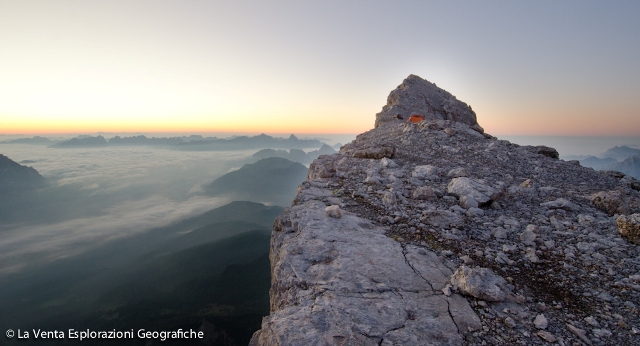
Near the camp, in the middle of the ridge, geologist Francesco Sauro and speleologist Roberta Tanduo from Padua spotted in the rock a series of depressions resembling, for shape and disposition, dinosaur footprints. A more attentive survey of the rocky surface revealed a track formed by five possible footprints disposed along the same direction and evenly distanced. The footprint are now documented with photos and videos by videomaker Enzo Procopio. Then the images were analyzed by paleontologist Matteo Belvedere PhD (University of Padua), who confirmed the hypothesis, declaring: “Almost all the depressions found are surrounded by a relief, an edge, said “expulsion edge”, that means the depression is not linked to karstification but to the impression of an object in the sediment. Because of their alignment, the depressions can be interpreted as footprints of a biped animal, but this hypothesis could be supported only by future surveys. The bad conservation state, due the karst nature of the rock and to the exposition to atmospheric agents, does’t allow to determine precisely the animal species. Nonetheless the dimensions (about 15-20 cm/6-8 inches of length) and the biped walk let us suppose that they could belong to a carnivorous dinosaur of little-middle dimension (3-4 meters/10-13 feet), similar to a Coelophysis. “
The discovery confirms the high paleontological potential of the Dolomites, rough mountains where the surfacing are often located on steep slopes or on almost inaccessible ridges. If the initial hypothesis will be confirmed, the footprints are among the highest found in Europe, second only to the ones found in Switzerland on the top of Piz Mitgel (3127 meters, 10260 feet asl).
Further surveys are going to be conducted during the next summer season and possibly the rocky surface of the ridge is going to reveal new tracks in the future. On its west indeed, on the walls of Mount Pelmetto, were already found other dinosaur tracks, marked on the rocky formation of the Principal Dolomia.